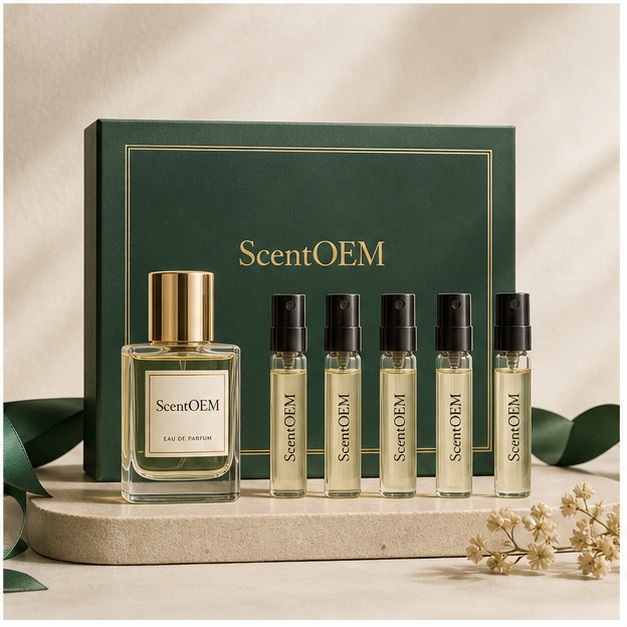
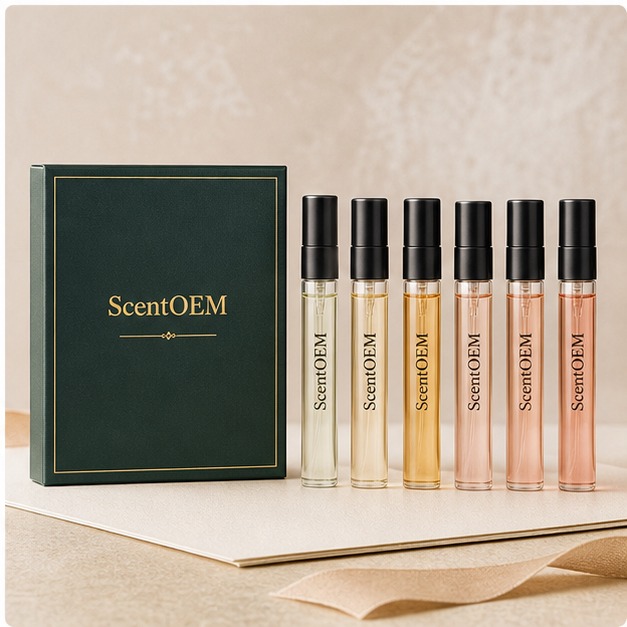
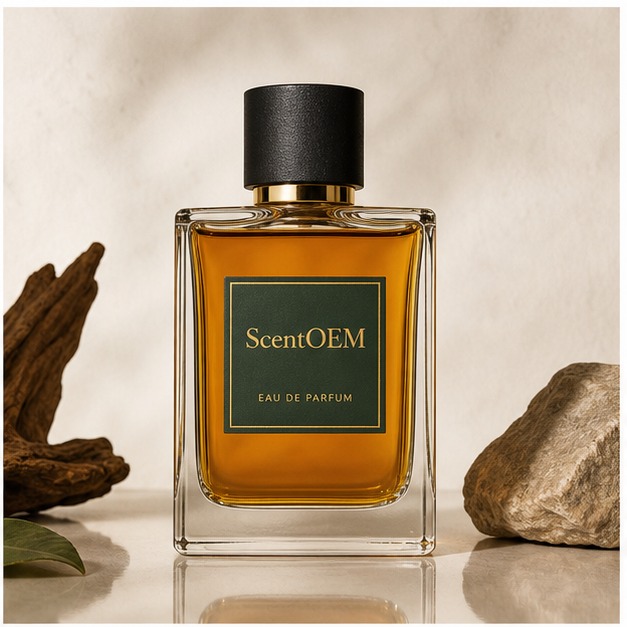
Three Paths, Not Two
The question is usually framed as private label versus custom, which hides the option that suits most projects. There are three routes, and the middle one is where a large share of launches actually land.
| Private label | An available fragrance direction, existing components, your branding on the label and retail packaging. The product is yours commercially; the formula and components are drawn from what already exists. |
|---|
| Semi-custom | An existing fragrance adjusted toward a brief, or a distinctive packaging configuration built from available parts. Retains the speed and minimums of existing components while moving the product away from a catalogue item. |
|---|
| Full custom | A fragrance developed from a brief. Requires scent development rounds, compatibility review, documentation work and explicit terms on ownership and exclusivity. |
|---|
Buyers who believe they need full custom development often need semi-custom: a recognisable, distinctive product that does not carry the development cost, extended timeline and higher minimums of an original formula.
Side-by-Side Comparison
Each path differs across the dimensions that determine whether a project is viable at the scale you are planning.
| Private label | Semi-custom | Full custom |
|---|
| Fragrance | Selected from available directions | Existing formula adjusted | Developed from a brief |
| Development rounds | None | Limited | Several, by nature |
| Time to first sample | Shortest | Moderate | Longest |
| Minimum | Lowest, set by components | Moderate | Highest, formula batch applies |
| Upfront cost | Lowest | Moderate | Development cost before production |
| Distinctiveness | Through branding and packaging | Product-level difference | Fully distinct scent |
| Exclusivity | Not inherent | Depends on terms | Negotiable and explicit |
| Documentation | Existing position for the formula | May need review after adjustment | Established during development |
| Risk if it does not sell | Contained | Moderate | Development investment is sunk |
| Typical fit | First launches, testing demand, gifting, retail range fill | Second runs, differentiating an established line | Signature products, exclusivity requirements, proven volume |
The Exclusivity Question
Exclusivity is the reason most often given for choosing full custom, and it is worth separating into its component concerns, because they have different answers.
- "Will a competitor sell the identical scent?" A legitimate concern with stock formulas. It is a question to raise directly and settle in terms, not an inherent property of any path.
- "Will my product look like everyone else's?" Largely a packaging question. Bottle choice, decoration and presentation differentiate strongly, even on a shared formula.
- "Do I need a scent nobody can replicate?" Rarely a first-run requirement. It matters for a signature product with established demand behind it.
- "Can I stop this formula being sold to others?" This is a commercial term, negotiated explicitly. It usually carries volume commitments in exchange.
Exclusivity, formula ownership and territory restrictions are commercial terms confirmed in writing for a specific project. They are not implied by choosing a particular path, and a supplier who treats them as automatic has not thought about what they are agreeing to.
Who Owns the Formula
Ownership is distinct from exclusivity and is frequently left vague until it matters — which is usually when a brand wants to move production or a relationship ends.
| Question to settle | Why it matters later |
|---|
| Who holds rights to a developed formula | Determines whether the scent can be produced elsewhere |
| Whether the formula can be supplied to others | Governs competitive exposure in your category |
| Whether any restriction is by territory, channel or absolute | A market-limited restriction behaves differently from a global one |
| What happens to it if the relationship ends | Decides whether a product line survives a supplier change |
| Whether development costs affect ownership | Paying for development does not automatically transfer rights unless stated |
These are worth raising before development begins rather than after a formula exists and both sides have invested in it.
Choosing by What You Are Actually Solving
Path selection follows from the constraint that is genuinely binding on your project.
| Testing whether a market exists | Private label. Keep the minimum and the investment contained until demand is evidenced. |
|---|
| Launch date is fixed | Private label, or semi-custom with available components. Development rounds do not compress reliably. |
|---|
| Budget is the binding limit | Private label, with packaging carrying the differentiation. |
|---|
| Existing line needs a distinct addition | Semi-custom. Product-level difference without full development. |
|---|
| Retailer requires exclusivity | Semi-custom or full custom, with the exclusivity term written explicitly. |
|---|
| Signature product with proven demand | Full custom. The volume justifies the development investment. |
|---|
| Specific scent that does not exist | Full custom, since no adjustment reaches it. |
|---|
| Corporate gift or event | Private label. Presentation carries the brand; the fragrance supports it. |
|---|
The working rule: choose the lowest-complexity path that still meets the brand, channel and market goal. Complexity beyond that point adds cost, time and risk without adding commercial value.
Why the Paths Are a Sequence, Not a Ranking
Full custom is often treated as the serious option and private label as the beginner's compromise. That framing costs new brands money.
The paths describe how much of the product is being changed, not how professional the buyer is. Established brands run private-label products in their ranges routinely — for gifting, for range extension, for testing a category. Meanwhile a new brand that commissions an original formula and a custom mould for a first run has committed its budget before learning anything about demand.
A more durable sequence is: prove the market on a contained first run, differentiate on the second, invest in an original formula once volume justifies it. Each stage funds the next and the information improves as the commitment rises.
Path Selection FAQ
Is private label perfume lower quality than custom?
No. The paths differ in how much of the product is newly created, not in production standard. A private-label product uses an existing fragrance and available components; it is made through the same processes and to the same specification discipline.
Can I start with private label and move to custom later?
Yes, and it is a common and sensible progression. A contained first run generates demand information, and a second run can then justify development investment on evidence rather than assumption.
Will a competitor be able to sell the same stock fragrance?
With a stock formula, that is a legitimate question to raise directly rather than assume either way. Exclusivity and territory restrictions are commercial terms confirmed in writing for a specific project. Packaging and branding also differentiate substantially on a shared formula.
How much more does full custom development cost?
It is confirmed per project rather than published, because it depends on the brief's complexity, how many development rounds are needed, testing scope and the resulting formula's own minimums. The structural difference is that development cost arrives before any unit is produced.
What is semi-custom in practice?
Typically an existing fragrance adjusted toward a brief, or a distinctive combination of available components — a particular bottle, closure and decoration set that no catalogue item matches. It moves the product away from a stock item while retaining most of the speed and minimum advantages of existing parts.
Continue From Here