Quick answer
Low-MOQ private label perfume in China is most feasible when the project uses an available fragrance direction, stock bottle, compatible standard pump and cap, simple decoration, one carton design and a small number of SKUs. The effective MOQ is not set by one number on a supplier’s homepage. It is set by the least flexible part of the formula, filling batch, bottle, pump, cap, decoration or printed packaging system.
A low finished-product quantity can still create excess component inventory. Buyers should request an MOQ breakdown by component and distinguish the number of finished units from the number of bottles, cartons or labels they must purchase.
One perfume project contains several MOQs
Suppliers often quote one “minimum order quantity,” but a perfume project contains several linked minimums.
| Layer | Why a minimum may apply |
|---|
| Fragrance mixture | Supplier batch, purchase pack or formula setup |
| Finished bulk | Mixing, filtration, holding and release efficiency |
| Bottle | Stock availability, color batch or glass production run |
| Pump and seal | Supplier case quantity and neck compatibility |
| Cap and collar | Stock pack, finish batch or tooling run |
| Decoration | Screen, pad, coating, metallization or label setup |
| Carton | Printing sheet, finishing and conversion efficiency |
| Filling | Line setup, cleaning, labor and batch documentation |
The effective project MOQ is controlled by the constraint that cannot be reduced or carried into a later order economically. A filling line may accept a small batch while the printed carton supplier requires more cartons than the buyer plans to fill.
This is why “Can you make 500 bottles?” is incomplete. A better question is: “Can you make 500 finished units of one scent using this bottle and carton, and what excess components would I need to buy?”
The lowest-risk low-MOQ route
A small first order usually works best with a controlled set of available options:
- an existing fragrance direction or previously developed base;
- a standard concentration route already supported by the supplier;
- a stock bottle with confirmed availability;
- a standard pump, collar and cap combination;
- a label or simple print method instead of complex decoration;
- a folding carton with standard material and finish;
- one bottle size and one packaging architecture; and
- one or a limited number of fragrances.
This route does not mean the product must look generic. Brand identity can come from scent selection, naming, color, label design, carton artwork, photography and customer experience. The key is to spend customization where it creates visible value without triggering a new industrial minimum at every component.
Low MOQ and full customization are different goals
Buyers often request a very small order and a custom fragrance, custom glass shape, custom cap, special pump color, multi-process decoration and rigid gift box at the same time. Each requirement adds a supplier, setup, test or tooling constraint.
Use this trade-off table:
| Choice | Low-MOQ effect | Main trade-off |
|---|
| Existing scent direction | Helps | Less fragrance exclusivity |
| Original fragrance development | May raise batch and development requirements | More differentiation |
| Stock clear bottle | Helps | Shared bottle shape |
| Custom bottle color | May add coating or glass-batch minimum | Stronger visual identity |
| Standard cap | Helps | Fewer distinctive finishes |
| Custom cap or mold | Usually raises minimum and tooling | Proprietary appearance |
| Pressure-sensitive label | Often helps | Different finish from direct printing |
| Multi-process decoration | Raises setup complexity | Premium appearance |
| Folding carton | Usually more flexible | Less structural impact than a rigid box |
| Rigid gift box | Often raises quantity and freight | Premium unboxing |
Low MOQ is a design constraint. Treat it as part of product strategy, not as a discount request after the design is complete.
Separate finished quantity from purchased quantity
Ask the supplier to show four numbers for every component:
- minimum purchase quantity;
- planned consumption quantity;
- expected production allowance or loss; and
- excess quantity remaining after the order.
For example, if a supplier must purchase more cartons than the number of perfumes being filled, the quotation should state who pays for the surplus, who owns it, where it will be stored and how long it can be used. Do not assume excess packaging is free or automatically kept for the next order.
A useful inventory table looks like this:
| Component | Purchase quantity | Planned use | Allowance | Expected excess | Owner after production |
|---|
| Bottle | To Confirm | To Confirm | To Confirm | To Confirm | To Confirm |
| Pump | To Confirm | To Confirm | To Confirm | To Confirm | To Confirm |
| Cap | To Confirm | To Confirm | To Confirm | To Confirm | To Confirm |
| Label | To Confirm | To Confirm | To Confirm | To Confirm | To Confirm |
| Carton | To Confirm | To Confirm | To Confirm | To Confirm | To Confirm |
This table exposes the real cash commitment better than a single finished-unit MOQ.
Reduce SKU multiplication
MOQ usually applies per fragrance, bottle color, artwork or packaging design—not only per purchase order. A launch with three scents and two bottle sizes may create six separate product combinations before gift sets or regional labels are added.
For a small first order, consider:
- one bottle size;
- one common bottle and cap across all scents;
- one packaging structure with artwork variations;
- fewer fragrances with clearer positioning;
- one language version where legally and commercially appropriate; and
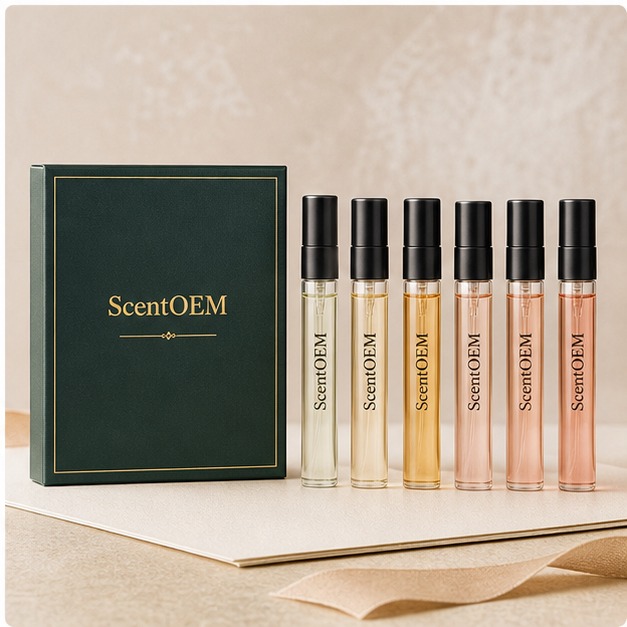
- a discovery set to support sampling without duplicating full-size packaging.
Fewer SKUs improve purchasing leverage, simplify approvals and reduce the risk of slow-moving packaging. Add variety after the buyer has sales evidence.
Ask whether the fragrance is truly production-ready
An “available fragrance” can mean several things: a fragrance oil in a library, a previously used finished formula, or a scent direction that still needs concentration, color, stability and packaging work.
Ask:
- Is the offer a fragrance mixture or a finished perfume formula?
- Which product format and intended-use category does it support?
- Has the exact formula been used with the proposed packaging?
- What sample and test work remains?
- Is the formula available for repeat orders?
- Can it be supplied to other brands?
- Which documents are available for the exact intended use?
Ready-to-customize should mean that the remaining work is defined. It should not mean “no testing or approval is needed.”
Compare low-MOQ quotations on total launch cash
A low unit quantity may have a higher unit price because setup, sampling, artwork, line preparation and documentation are spread across fewer finished units. That can still be a sensible decision if it reduces unsold inventory.
Compare:
- development and sample fees;
- component purchase quantities;
- decoration and printing setup;
- tooling or fixtures;
- testing and document costs;
- filling and assembly;
- inspection;
- export packing and dangerous-goods freight;
- storage of excess components; and
- expected reorder cost and availability.
The best pilot order is not necessarily the cheapest per bottle. It is the order that creates enough reliable market evidence without locking too much cash into untested product or obsolete packaging.
Protect the reorder before launching
Small brands often focus on the first order and discover later that a bottle, cap or fragrance direction is no longer available. Ask the supplier to explain the reorder route before approving the first sample.
Confirm:
- whether components are stocked or purchased per order;
- expected component availability window;
- whether unused components can be reserved;
- storage terms and risk of damage or obsolescence;
- minimums for a normal reorder;
- whether the formula or fragrance code will remain available;
- how substitutions are approved; and
- how long retained samples and records are kept.
A successful low-MOQ launch is only useful if the brand can reproduce the product after demand is proven.
A low-MOQ inquiry template
Send the supplier enough detail to identify a feasible route:
We are planning a first order of [quantity] finished units, [number] fragrance(s), [size] per bottle, for sale in [destination]. We prefer an available fragrance route and stock bottle to control MOQ. Please itemize the minimum purchase quantity, planned use and expected excess for the fragrance, bottle, pump, cap, decoration and carton. Please also confirm sample stages, document availability, production start conditions and reorder minimums.
Attach visual references, but state which features are essential and which can change to support the pilot quantity.
Red flags in a low-MOQ offer
- One MOQ is quoted without component-level detail.
- The supplier promises full custom molds at a pilot quantity with no tooling explanation.
- The sample uses components different from the proposed order.
- Excess packaging ownership is not stated.
- The quotation excludes setup fees but the supplier will not confirm whether they exist.
- The supplier cannot explain whether MOQ applies per scent or per order.
- Very low quantity is offered only after the buyer pays for a much larger packaging batch.
- Reorder availability is described as “no problem” without component codes or terms.
How ScentOEM approaches low-MOQ projects
ScentOEM is a sourcing and project-coordination partner. It can help buyers simplify the brief, identify available component routes and request a component-level MOQ breakdown. It does not guarantee a universal low minimum because feasibility depends on the exact formula, packaging, quantity and destination.
Use the MOQ and Cost Guide, the detailed Perfume MOQ Guide and Private Label Perfume before sending a project request.
Frequently asked questions
What is a low MOQ for private label perfume in China?
There is no universal number. The feasible quantity depends on the fragrance route, bottle, pump, cap, decoration, carton, number of scents and the supplier’s production setup. Request a project-specific breakdown.
Can I use a custom fragrance at low MOQ?
Possibly, but original development may add fees, testing and batch constraints. A modified or available fragrance route is usually easier for a small launch.
Can I order different scents within one MOQ?
Sometimes, but minimums may apply per fragrance or formula batch. Common packaging can help, but separate liquids still require separate preparation, filling and release.
Why does the carton MOQ exceed the perfume MOQ?
Printing and finishing processes have their own setup economics. The carton supplier may require more pieces than the filling factory needs. The excess must be priced and assigned.
Is a higher MOQ always cheaper overall?
It may lower unit cost, but it increases inventory, storage and demand risk. Compare total cash exposure and likely sell-through, not only cost per bottle.
Sources and further reading