
Product Category

Private Label Reed Diffusers for Home Fragrance Lines

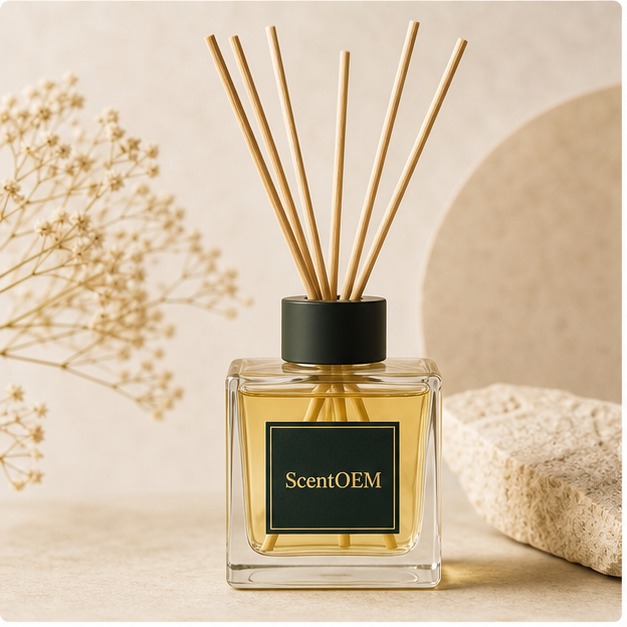
Reed diffusers can extend fragrance brands into home scent, gift and lifestyle programs. Bottle, reeds, fragrance base, label, box, carton and document needs should be reviewed before quotation.

How a Reed Diffuser Works

A reed diffuser has no heat source and no power. Fragrance base travels up porous reeds by capillary action and evaporates from the exposed length. Everything about the product's performance follows from that mechanism.

Reed porosityDetermines how quickly base travels upward. Natural rattan and synthetic fibre reeds behave differently, and the choice affects both throw and longevity.
Reed countMore reeds mean more evaporating surface — stronger scent, shorter life. This is the customer's own adjustment mechanism.
Neck openingA narrow neck restricts evaporation from the liquid surface and limits spill risk; a wide neck does the opposite.
Base formulationThe carrier's viscosity and volatility determine whether it climbs the reeds at a useful rate at all.
Room conditionsTemperature, airflow and room size affect perceived strength more than buyers expect, which is why performance is described in ranges.

Because the mechanism depends on the interaction of base, reeds and bottle neck, performance is confirmed on the actual selected combination during sampling rather than predicted from a specification. A base that works well with one reed type may underperform with another.

The Components and What Each Decides

BottleGlass or ceramic, with neck opening being the functionally important dimension. Also the visible object in the customer's room, so it carries the design.
ClosureA shipping cap plus, usually, a decorative collar or stopper the customer keeps. Two different parts serving different purposes.
ReedsMaterial, length and count. Length should suit the bottle height; too short and capillary action is limited, too long and the product looks unbalanced.
BaseFragrance load in a carrier. The carrier choice affects performance, appearance and applicable requirements.
LabelMust accommodate required safety text alongside brand design — usually the tightest constraint on the layout.
Retail boxProtects in transit and carries the gift proposition. Home fragrance sells heavily as a gift.

Why Fragrance Brands Add Home Scent

  • Extends a scent world beyond the body. A signature fragrance in a room diffuser deepens brand presence in the customer's daily environment.
  • Different purchase occasion. Home fragrance is bought for the home and as a gift, reaching buyers who may not buy personal fragrance.
  • Strong gifting performance. A diffuser is easy to give — no preference guess about how it will smell on someone.
  • Hospitality channel. Hotels, spas and retail spaces buy at volume for scenting environments.
  • Predictable replenishment. Diffusers deplete on a reasonably regular cycle, supporting refill and repeat sales.
  • No transport classification complexity of aerosols. Though base composition still determines the shipping profile.

Safety Text and Market Requirements

Home fragrance products carry labelling obligations that personal fragrance does not, and this catches out brands extending from perfume into the category.

  • Hazard and precautionary text may be required depending on the base composition and destination market, and it occupies meaningful label area.
  • Usage and safety warnings — keep away from children, avoid contact with surfaces, do not ignite — are commonly required.
  • Surface damage cautions matter because the base can affect finished furniture, and this is a frequent consumer complaint.
  • Ingredient or allergen disclosure requirements vary by market.
  • Transport documentation depends on the base composition rather than the product category.
  • Child-safety considerations apply to closure design in some markets.

Required text is confirmed for the selected base and destination market, and it must be designed into the label from the first layout. Adding it afterwards to a design built without space for it means a redraw — see the artwork guide and the documentation guide.

Reed Diffuser FAQ

How long does a reed diffuser last?

It depends on fill volume, reed count and material, neck opening, base formulation and room conditions including temperature and airflow. Because several of these are under the customer's control — particularly reed count — performance is described as a range confirmed on the actual combination rather than a fixed figure.

Can I use my perfume fragrance in a diffuser?

The scent direction can usually be translated, but the formulation is different. A diffuser base must climb the reeds by capillary action and evaporate at a useful rate, which a perfume formulation is not built to do. Whether a direction translates well is confirmed during sampling.

What determines how strong a reed diffuser smells?

Mainly the evaporating surface area — reed count and exposed length — together with base formulation, neck opening and room conditions. Reed count is the customer's own adjustment, which is why usage guidance on the label matters.

Do reed diffusers need safety warnings on the label?

Commonly yes. Depending on base composition and destination market, hazard and precautionary text, usage warnings and surface-damage cautions may be required. This takes real label area and should be designed in from the first layout rather than added later.

Which reeds should a project use?

Natural rattan and synthetic fibre reeds differ in porosity and therefore in throw and longevity. Length should suit the bottle height for both performance and appearance. The right choice is confirmed against the selected base during sampling.