The Role Room Spray Plays
Room spray is the immediate, controllable member of the home fragrance family. Where a diffuser scents continuously and a candle requires attention and time, a spray delivers scent on demand and stops when the user stops.
That makes it the format of choice for specific moments rather than ambient background:
- Before guests arrive — instant effect with no lead time.
- Targeted areas — bathrooms, entryways, wardrobes and linen, where continuous scenting is unnecessary.
- Where flame is not an option — offices, hotels, rentals and homes with children or pets.
- Between diffuser refills — a top-up for the same scent world.
- Travel and temporary spaces — hotel rooms and short lets.
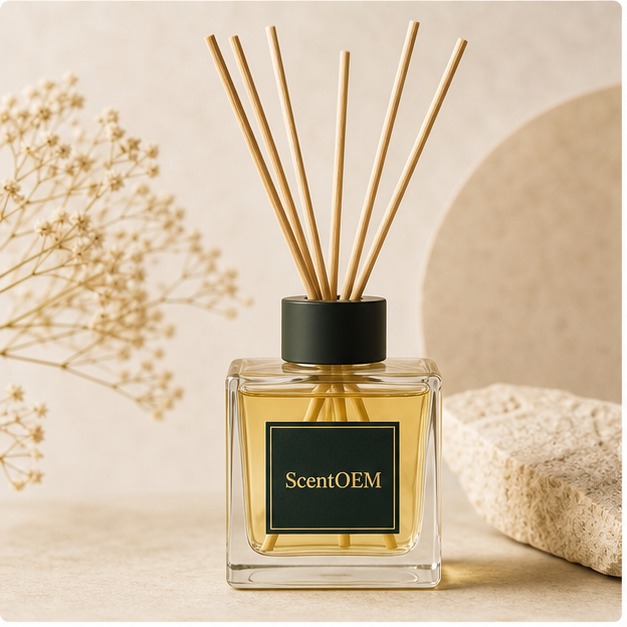
Because it complements rather than replaces the other formats, room spray is commonly sold alongside a matching diffuser and candle as a home fragrance range.
The Surface Question
The most common consumer complaint about room sprays is not the scent — it is what happens when the spray lands on something. This is a formulation and labelling matter that should be settled during scoping rather than discovered through returns.
| Spray pattern | A finer mist stays airborne longer and settles less heavily. Pump selection materially affects perceived quality. |
|---|
| Formulation base | The carrier determines drying behaviour and how the product interacts with finished surfaces and fabrics. |
|---|
| Fabric positioning | If the product will be marketed for linen or upholstery, that is a formulation requirement, not a marketing decision made afterwards. |
|---|
| Required cautions | Surface and fabric warnings are commonly needed on the label, and they take space. |
|---|
| Usage guidance | Spray into the air rather than directly at surfaces — worth stating clearly on the packaging. |
|---|
If linen or fabric use is intended, say so at the enquiry stage. It changes which formulations are suitable and which claims can be made, and retrofitting a fabric claim onto a formulation not designed for it is not possible.
Hospitality and Volume Programmes
Hotels, spas and retail spaces buy room spray differently from consumers, and the specification priorities shift accordingly.
- Consistency across repeat orders matters more than novelty — the scent is part of a property's identity.
- Larger formats or refills for back-of-house use, alongside guest-facing retail units.
- Durable, simple packaging for staff use, which differs from a gift presentation.
- Signature scent development where a property wants an exclusive identity across its spaces.
- Coordinated ranges — spray, diffuser and amenity products sharing one scent.
- Predictable replenishment schedules tied to occupancy rather than retail seasons.