
Quick answer
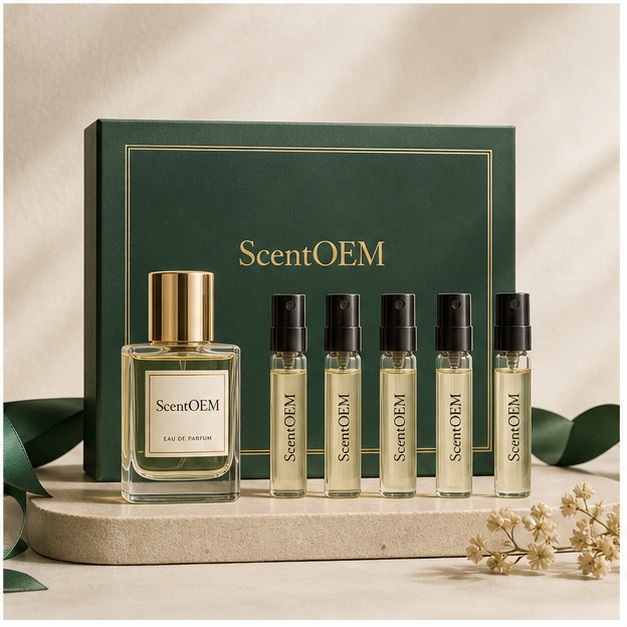
Custom perfume packaging in China should be managed as one integrated system, even when glass, pump, cap, decoration and cartons come from different suppliers. Create a packaging bill of materials, assign one owner for every interface, approve exact component codes and physical samples, verify compatibility, and define who purchases, inspects, stores and replaces each component.
The most common packaging failures occur between suppliers: a pump does not fit the bottle neck, a cap rubs the coating, artwork uses the wrong dieline, or carton timing delays the filling line.
Build a packaging bill of materials
Create one controlled list:
| Item | Required specification |
|---|---|
| Bottle | Size, glass, neck, color, dimensions, weight, supplier code |
| Pump | Mounting, seal, tube, actuator, finish, supplier code |
| Collar | Fit, material, finish, dimensions |
| Cap | Structure, fit, finish, orientation, supplier code |
| Decoration | Method, position, color standard, adhesion criteria |
| Label | Material, adhesive, size, print and application position |
| Carton | Dieline, board, print, finish, insert and closure |
| Gift set | Tray, secondary items, assembly and protection |
| Shipping pack | Units, dividers, carton, marks and pallet plan |
Every revision needs a version and approval date. Do not allow separate supplier quotations to become separate specifications.
Assign the interface owner
For each connection, identify who confirms fit and who pays if it fails:
- bottle neck to pump and seal;
- pump to crimp tooling;
- collar to pump;
- cap to collar and bottle shoulder;
- decoration to cap contact points;
- label to coating and bottle curvature;
- bottle to carton insert;
- finished pack to shipping carton.
If no one owns the interface, each supplier may deliver a component that meets its own drawing while the complete package fails.
Decide stock, decorated stock or custom mold
Stock component
Fastest and usually most quantity-flexible. Confirm current availability, supplier code and reorder route.
Decorated stock component
Uses an existing bottle or cap with color, coating, print, label or metallization. Decoration creates new setup, color and adhesion decisions.
Custom mold
Provides stronger visual ownership but adds design, engineering, tooling, trials, minimums and mold-ownership terms. A custom shape should solve a brand or functional problem that justifies the exposure.
Many first launches are better served by a distinctive decoration and carton around proven stock components.
Control drawings and dielines
Before artwork begins, obtain the approved bottle drawing, decoration area, label template and carton dieline. Record whether the file is supplier-issued, buyer-created or preliminary.
Artwork release should include:
- source file and PDF proof;
- dimensions and bleed;
- color references;
- font handling;
- barcode requirements;
- print/finish layers;
- version and approval;
- market text requiring qualified review.
Use the Perfume Artwork File Checklist before sending files to production.
Approve color and finish physically
Screen color is not a reliable production color standard. Request physical samples or agreed color references for glass, coating, print, cap and carton.
Evaluate finishes under defined lighting and on the actual substrate. Metallic, translucent and textured surfaces can shift appearance. Record acceptable variation rather than expecting every component to look digitally identical.
Also test handling. A beautiful coating that scratches during cap assembly or carton insertion is not production-ready.
Coordinate MOQ across suppliers
Request minimum purchase quantity, planned use and excess for every component. The bottle may support the finished quantity while the cap finish or carton print requires more pieces.
Reduce complexity by:
- using one bottle and cap across scents;
- varying artwork rather than structure;
- selecting available finishes;
- combining orders only where specifications truly match;
- avoiding unnecessary color versions;
- planning ownership and storage of excess parts.
For a broader packaging decision framework, review the Perfume Packaging Guide.
Align the packaging timeline with filling
The filling date depends on the last required approved component. Build a stage schedule:
- component selection;
- drawing and dieline release;
- prototype or physical sample;
- decoration trial;
- compatibility review;
- artwork approval;
- component production;
- incoming inspection;
- pre-production line trial;
- filling and assembly.
Do not treat the factory’s “production lead time” as the entire project timeline. Packaging procurement may begin only after deposits and approvals.
Define incoming inspection
Each supplier should know the characteristics that will be checked when components arrive at the assembly site.
Possible characteristics include:
- quantity and identification;
- dimensions and fit;
- glass defects;
- color and finish;
- print and decoration;
- contamination or damage;
- pump function;
- cap alignment;
- carton construction;
- packaging and transport damage.
Define sampling, defect categories and responsibility for replacement or sorting. The filling site should not be forced to accept unsuitable components because the launch date is close.
Protect molds, files and excess components
For custom work, put ownership and access in writing:
- who pays for and owns molds;
- where molds are stored;
- maintenance and useful-life assumptions;
- whether the supplier may use the mold for others;
- access to drawings and source files;
- ownership of unused bottles, caps and boxes;
- storage fees and conditions;
- treatment after termination.
Important IP and contract terms require qualified legal review.
A packaging approval gate
- [ ] Bill of materials and component codes complete
- [ ] Bottle/pump/seal interface approved
- [ ] Cap/collar fit approved
- [ ] Decoration sample approved
- [ ] Artwork and dielines released
- [ ] Carton and insert fit approved
- [ ] Formula-package compatibility plan complete
- [ ] Line trial or equipment fit confirmed
- [ ] Incoming inspection criteria agreed
- [ ] MOQ and excess inventory assigned
- [ ] Mold and file ownership documented
- [ ] Supplier substitutions require approval
- [ ] Shipping-pack configuration approved
How ScentOEM supports packaging coordination
ScentOEM is a sourcing and project-coordination partner. It can help organize component requirements, collect supplier information and align packaging approvals with perfume production. It does not claim to manufacture every bottle, pump, cap or carton itself.
Review Packaging Customization, the Perfume Packaging Guide and Bottle, Pump and Crimp Compatibility after publication.
Frequently asked questions
Can one factory make the bottle, pump, cap and box?
Sometimes a group offers several processes, but specialist suppliers commonly produce different components. Ask who makes and controls each item.
Should I choose the bottle before the fragrance?
Packaging selection can begin early, but final formula and package approval should converge before compatibility and production release.
Is a custom bottle necessary for a premium brand?
No. Premium positioning can come from scent, glass quality, decoration, cap, carton and brand execution. Custom molds should have a clear commercial purpose.
Who should own the packaging specification?
The buyer should retain a controlled master version, while suppliers maintain the production details they are responsible for. One project owner should coordinate changes.
What happens if one component is late?
The filling and assembly schedule may move. Build milestone visibility and define whether partial delivery, alternative components or rescheduling are allowed.