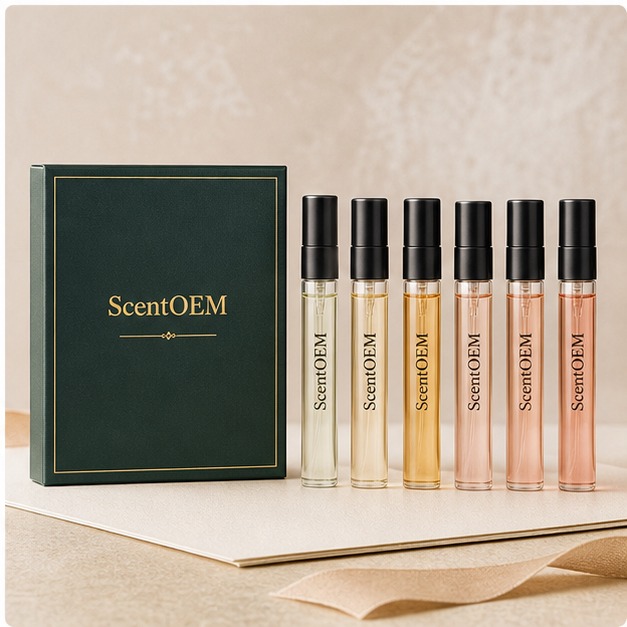
The Six Decisions in a Perfume Pack
Packaging is where most of a perfume project's cost, minimum and timeline actually get decided — usually more than the fragrance itself. It is also where buyers most often specify in the wrong order, and pay for it in rework.
A finished retail unit involves six independent decisions, each sourced from a different production process:
| Bottle | Capacity, shape, glass weight, colour and surface finish. Available mould or custom mould. |
|---|
| Closure | Cap, atomizer, pump, collar and crimp. Standard components or bespoke finishes. |
|---|
| Decoration | Screen printing, hot stamping, coating, frosting, metallising or a printed label. |
|---|
| Label | Material, adhesive, dimensions, dieline, finish and required market text. |
|---|
| Retail presentation | Folding carton, rigid box, sleeve, insert, cradle and any gift-set structure. |
|---|
| Export packing | Master carton, inner divider, unit count per carton and transport protection. |
|---|
Each carries its own setup cost and run minimum. That is why a change to one item — a cap finish, a box construction — can move the whole project's floor without changing anything a buyer would describe as "the product".
The Order to Decide Them In
Sequencing matters because later decisions are constrained by earlier ones, and reversing that order forces rework at the sampling stage.
| Step | Decide | Because it constrains |
|---|
| 1 | Product format and fill volume | Which bottles exist at that capacity at all |
| 2 | Price position and channel | How much packaging investment the unit can carry |
| 3 | Bottle and closure | Label dimensions, decoration method and box internals |
| 4 | Decoration approach | Artwork format, setup cost and run minimum |
| 5 | Retail presentation | Carton dimensions and assembly scope |
| 6 | Export packing | Freight volume and per-unit shipping cost |
The most common sequencing error is designing the retail box before the bottle is fixed. Box internals are built around the exact bottle and closure, so a bottle change after box artwork is approved means redrawing the dieline and repeating the print setup.
Bottle: the Decision That Sets the Rest
The bottle is the highest-leverage packaging choice, and the split that matters is not shape or colour — it is whether the mould already exists.
| Available mould | Custom mould |
|---|
| Minimum | Set by the component run | Substantially higher — mould economics apply |
| Setup | None for the mould itself | Tooling cost before any unit is made |
| Lead time | Shorter; stock may be on hand | Longer; tooling and first-article approval |
| Differentiation | Achieved through decoration and presentation | Structural and exclusive to the brand |
| Typical fit | First runs, launches, testing demand | Established lines with proven volume |
A great deal of visual distinctiveness can be achieved on an available bottle through colour, coating, closure choice and decoration. Commissioning a mould for a first run is the most frequent reason a new brand's minimum lands far above plan, and it is rarely the change that decides whether the product sells.
Decoration and Where Cost Hides
Decoration is where the perceived value of a perfume is largely created, and where cost accumulates in ways that do not appear on a component list.
| Printed label | Lowest setup and lowest run minimum. Supports full-colour artwork and complex detail. The pragmatic default for a first run. |
|---|
| Screen printing | Applied directly to glass. Setup is per colour, so each additional colour adds cost and minimum. |
|---|
| Hot stamping | Metallic finish with strong shelf presence. Requires a die; fine detail has practical limits. |
|---|
| Coating and frosting | Changes the whole bottle surface. A separate process step with its own run minimum and yield considerations. |
|---|
| Metallised closures | Raises the closure's perceived value. Bespoke finishes carry higher minimums than standard parts. |
|---|
Two hidden costs are worth naming. First, each decoration process is a separate setup — a bottle with screen printing, a hot-stamped cap and a foiled box carries three setups, not one. Second, added process steps affect yield, and the effective per-unit cost reflects that, not just the quoted process price.
Retail Box, Gift Box and Carton
Boxes divide into two families with very different economics, and the distinction is structural rather than aesthetic.
| Folding carton | Printed and creased flat, folded at assembly. Lower minimum, lower freight volume, faster to produce. Suitable for most retail and ecommerce presentations. |
|---|
| Rigid box | Constructed board with wrap. Higher perceived value, higher minimum, more assembly labour, more freight volume. Common for gift and premium positioning. |
|---|
| Inserts and cradles | Foam, moulded pulp, board or EVA. Sized to the exact bottle, so a bottle change invalidates them. |
|---|
| Sleeves and bands | A low-cost route to seasonal or market-specific variants without a new box run. |
|---|
| Master carton | Determines units per carton, freight volume and transit protection. Reviewed against the destination and shipping mode. |
|---|
A sleeve over a folding carton frequently holds a price position that a buyer assumed required a rigid box, at a fraction of the minimum. It is worth testing that assumption before committing.
Compatibility, and Why It Is Checked Late
Fragrance and packaging are not independent. A formula interacts with the materials it sits in, and that interaction is confirmed against the actual selected combination rather than predicted from a specification.
- Formula and closure materials — gaskets, pumps and dip tubes are reviewed against the selected formula.
- Formula and decoration — some surface treatments behave differently in contact with certain formulations.
- Label adhesive and bottle finish — coated, frosted and untreated glass do not accept adhesives identically.
- Fill volume and headspace — affects both appearance and transport behaviour.
- Insert fit and transit — a cradle that fits on a desk may not hold through freight handling.
This is why sampling exists as a distinct stage rather than a formality. Compatibility, appearance and packaging fit are confirmed on the actual selected combination before bulk production is planned — see the sample process guide.
The Packaging Brief
A reviewable packaging brief answers these before component selection begins:
- Product format and fill volume.
- Price position and sales channel — retail shelf, ecommerce, gift or hospitality.
- Bottle preference, or reference images of the intended direction.
- Decoration expectation, and which element carries the brand.
- Retail presentation level — plain, printed carton, sleeve or rigid gift box.
- Artwork readiness — see the artwork file checklist.
- Quantity range and SKU count.
- Destination market, which drives required label text.
- Launch date, which determines workable component lead times.
Component availability, formula compatibility, artwork readiness, quantity, schedule and destination requirements are confirmed against the specific project rather than promised in advance.
Packaging FAQ
Can I use a custom bottle shape on a first run?
It is possible but rarely advisable. A custom mould introduces tooling cost and a substantially higher minimum before a single unit ships. Most first runs achieve distinctiveness through colour, closure and decoration on an available bottle, and commission tooling once volume justifies it.
Which decoration gives the most shelf impact for the cost?
A well-executed printed label, usually. It carries the lowest setup and run minimum while supporting full-colour artwork, and pairs well with a considered closure. Hot stamping and screen printing add impact but each is a separate setup.
Do I need a rigid box to look premium?
Not always. A folding carton with good print finishing, paired with a sleeve or band, holds many premium positions at a materially lower minimum. Rigid construction earns its cost mainly in gift and hospitality contexts.
Why can packaging feasibility not be confirmed from a description?
Because it depends on component availability at the time of the project, compatibility with the selected formula, artwork readiness, quantity, schedule and destination requirements. Each is project-specific, and a general answer would not survive contact with the actual specification.
When should artwork be prepared?
After the bottle and closure are selected, because label dimensions and box dielines are built around them. Preparing artwork earlier usually means redrawing it.
Continue From Here