What a Sample Can and Cannot Tell You
Sampling is the stage where a project stops being a specification and becomes a physical object. It is also the stage buyers most often rush, usually because it feels like a delay before the real work of production.
It is worth being precise about what the exercise settles.
| A sample confirms | A sample does not confirm |
|---|
| Fragrance direction, strength and how it develops on skin | How the scent will be received by your market at scale |
| Bottle feel, weight, closure action and spray quality | That every unit in a bulk run will be visually identical |
| Label legibility, artwork reproduction and finish | That the artwork satisfies destination-market label requirements |
| Packaging fit — whether components actually work together | Transit performance over a full freight route |
| Compatibility between the formula and its components | Long-term stability beyond the review period |
The distinction that matters commercially: a sample proves the specification is right, not that production will be identical. Batch variation, component lot differences and assembly tolerances are separate conversations, handled through specification and quality checkpoints rather than by looking at one unit.
The Sample Types and What Each Settles
Not every project needs every type, and asking for the wrong one wastes a round. These are the distinct purposes a sample can serve.
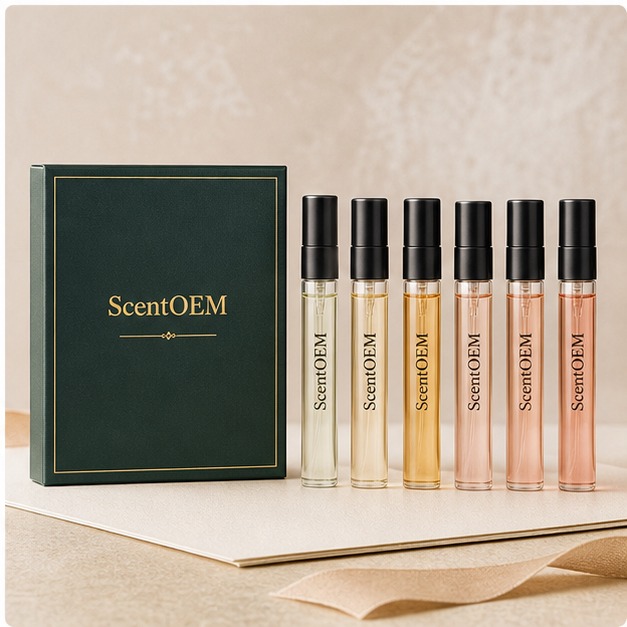
| Scent reference | Fragrance only, often in a plain vial or simple bottle. Settles direction and strength before any packaging decision is made. Fastest and least expensive round. |
|---|
| Component sample | Empty bottle, cap, atomizer or box. Settles feel, finish and construction. Useful when the packaging decision is the open question rather than the scent. |
|---|
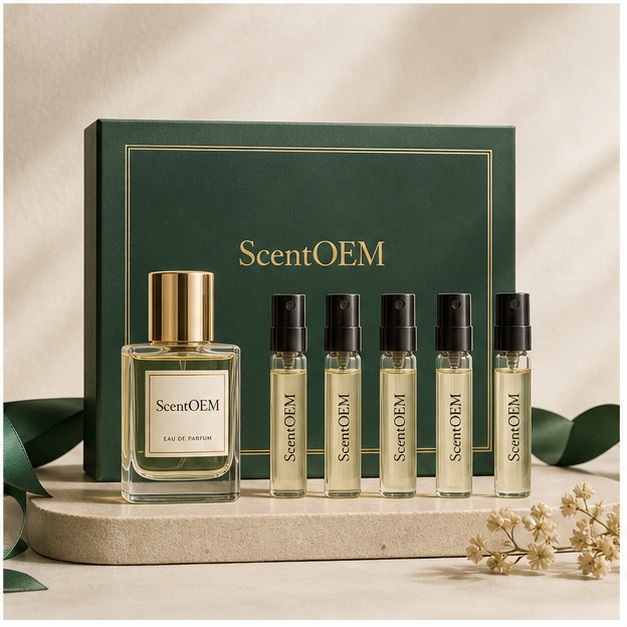
| Filled sample | Selected formula in the selected bottle. Settles how the two behave together, including spray performance and appearance in the actual glass. |
|---|
| Labelled or decorated sample | Adds artwork reproduction, decoration quality and adhesive behaviour on the chosen bottle finish. |
|---|
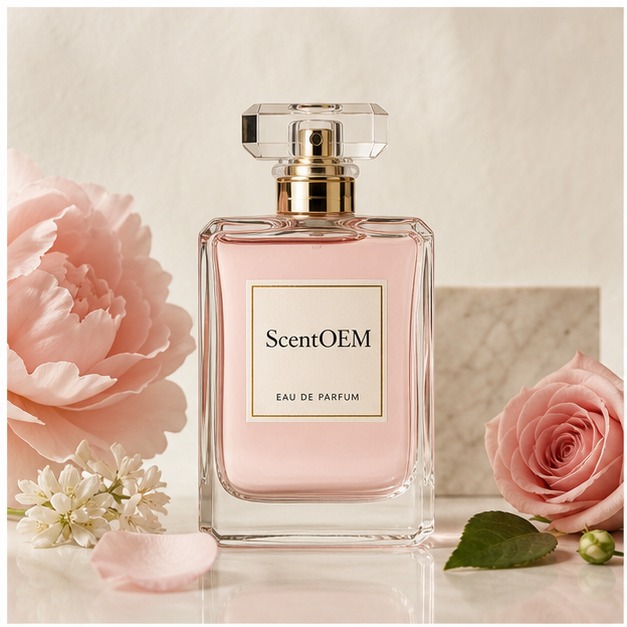
| Full presentation sample | The complete retail unit — bottle, decoration, label, box and insert. The closest approximation to what a buyer receives, and the appropriate basis for final approval. |
|---|
Projects generally move through these in order, though a wholesale project starting from a catalogue item may need only a filled sample, while a full custom development will run several scent references before packaging is touched at all.
How the Process Runs
- Submit the project scope. Commercial path, product category, fill volume, fragrance direction, packaging level, quantity range and destination market.
- Missing inputs are identified. Rather than assuming defaults, gaps that would make the sample unrepresentative are named first.
- A sample route is agreed. Which type of sample, covering which open questions, in what sequence.
- The formula or product direction is confirmed. Sampling proceeds against a stated specification, so feedback can be attributed to something specific.
- Samples are prepared and sent. Timing depends on the factors set out below.
- Evaluation and structured feedback. Scent, bottle, spray, label, packaging fit and any documentation questions.
- Revision rounds where needed. Expected, not a failure — each round narrows the specification.
- Approval against a written scope, then quotation and bulk planning.
Approving samples against a written specification matters more than it sounds. It is the reference point if a bulk run is later questioned, and without it both sides are relying on memory of a physical object.
Evaluating a Fragrance Sample Properly
Fragrance evaluation is unusually easy to get wrong, and a rushed assessment produces feedback that sends the next round in the wrong direction.
- Assess over time, not on opening. A fragrance changes across top, heart and base. Judging in the first minute assesses only the opening.
- Test on skin as well as on paper. Blotters show the structure; skin shows what the customer experiences.
- Limit how many you assess in one session. Olfactory fatigue sets in quickly and later samples are judged unfairly.
- Involve the people who represent your market. Personal preference and market preference are different things, particularly across regions.
- Assess strength separately from character. "Too weak" and "wrong direction" call for entirely different adjustments.
- Check the spray, not just the scent. Pattern, volume per actuation and pump feel are part of the product experience.
- Look at the label under retail conditions. Legibility and finish read differently under shop lighting than on a desk.
Feedback That Speeds Up the Next Round
Vague feedback costs a round. "We don't love it" cannot be acted on; a specific observation can. The pattern that works is: what you observed, how it differs from the intention, and which direction to move.
| Instead of | Send |
|---|
| "Too strong" | "Opening is sharp for the first ten minutes, then settles well. Soften the opening, keep the base." |
| "Doesn't last" | "Noticeable for about two hours on skin. Our market expects a working day." |
| "Wrong direction" | "Reads floral; our market wants the woody-amber character in this reference." |
| "Packaging feels cheap" | "Cap is lighter than expected and the label finish is matte where we intended gloss." |
| "Spray isn't good" | "Output is a jet rather than a mist; we need a finer dispersion." |
Reference materials help more than adjectives. A competitor product, a named note, or a physical sample of a finish you want communicates in one step what a paragraph struggles to convey.
What Actually Drives Sample Timing
Sample timing is confirmed per project rather than published as a fixed figure, because it is the sum of several independent variables.
| Formula path | An available fragrance can be filled from stock. An adjusted formula needs compounding. A newly developed scent runs through creation rounds before anything is filled. |
|---|
| Component availability | An in-stock bottle and cap move quickly. Components requiring a production run do not. |
|---|
| Decoration and artwork | Decorated or labelled samples need artwork finalised, and setup for the decoration process itself. |
|---|
| Number of variants | Three scent directions take longer to prepare and evaluate than one. |
|---|
| Buyer feedback speed | Frequently the largest single factor. A round waiting a fortnight for feedback adds a fortnight. |
|---|
| Shipping | Fragrance samples ship under transport rules that affect carrier and route options. |
|---|
The controllable half of that list sits with the buyer: settling the brief before sampling starts, limiting variants to what will genuinely be assessed, and returning structured feedback promptly.
Sample FAQ
How long does a perfume sample take?
It is confirmed per project rather than published as a fixed figure, because it depends on the formula path, component availability, whether decoration and artwork are involved, the number of variants and how quickly feedback returns. An available formula in a stock bottle is a very different exercise from a newly developed scent in decorated packaging.
How many sample rounds are normal?
Stock or private-label projects often need few, since the fragrance already exists. Custom development typically runs several scent rounds before packaging is addressed. Rounds are part of the process rather than a sign something has gone wrong — each one narrows the specification.
Can I sample several fragrances at once?
Yes, and it is often efficient. Assess them across separate sessions rather than back to back — olfactory fatigue makes later samples in a single sitting difficult to judge fairly.
Does an approved sample guarantee bulk production matches it exactly?
An approved sample sets the reference specification that bulk production is planned against. Natural batch variation, component lot differences and assembly tolerances exist in any manufactured product, which is why approval is recorded against a written scope rather than a remembered impression.
Should packaging be sampled separately from the fragrance?
Often yes, when the two are open questions at the same time. Settling scent direction on a plain sample first, then reviewing components, avoids paying for decorated samples of a fragrance that has not been chosen yet.
Continue From Here