What a Discovery Set Actually Solves
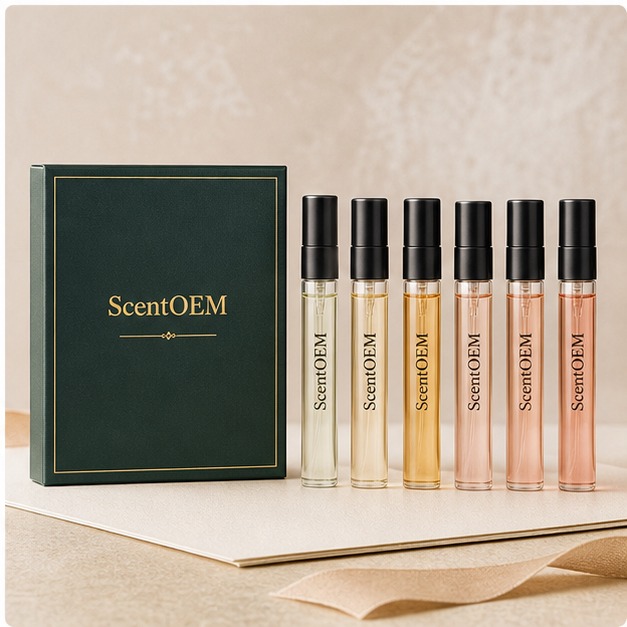
Fragrance has a structural problem that most product categories do not: customers cannot assess it before buying, and they know it. A discovery set exists to remove that barrier, and it does three commercially distinct jobs.
| Removes purchase risk | A customer unwilling to commit to a full bottle of an unknown brand will often try a low-priced set. It converts hesitation into a first transaction. |
|---|
| Generates demand information | Which scent in the set drives full-size reorders is the single most useful data a new brand can have before committing volume to one direction. |
|---|
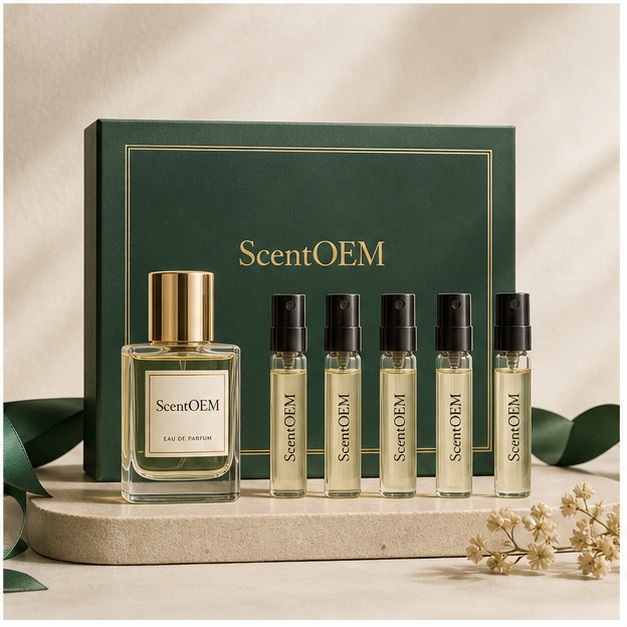
| Creates a gift product | A multi-scent set is easier to give than a single fragrance, because it does not require the giver to guess a preference. |
|---|
The second of these is frequently overlooked and is usually the most valuable. A brand launching a single full-size scent learns whether that one worked. A brand launching a discovery set learns which of several directions its actual buyers prefer — before the volume decision is made.
Set Structure and How Many Scents
Set size is a trade-off between choice and cost. More scents mean more component minimums, more assembly and a higher unit price; fewer mean a weaker sampling proposition.
| Set size | Suits | Consideration |
|---|
| 2–3 scents | Focused ranges, gifting, low price entry | Simplest to assemble; limited comparison for the customer |
| 4–6 scents | Testing directions, the common retail discovery format | Good balance of choice and cost; the usual default |
| 7+ scents | Established ranges, collector positioning | Assembly and component minimums rise sharply per set |
Each scent in a set is a separate formulation with its own batch, and anything printed per variant carries its own minimum. A six-scent set is closer to six small projects than to one — which is why set size affects the floor more than buyers expect.
Vial, Mini Spray or Small Bottle
The unit format inside the set changes both the cost and the customer's experience of it.
| Sample vial | Lowest component cost, smallest fill. Usually dab or dip application. Suitable for seeding and low-cost trial, though it reads as a sample rather than a product. |
|---|
| Mini spray | A small atomizer bottle. Reproduces the full-size experience, including spray behaviour, which matters if the customer is deciding whether to buy the full bottle. |
|---|
| Small bottle | A miniature of the retail bottle. Highest perceived value and the strongest gift proposition; also the highest component cost. |
|---|
| Roll-on | For oil-based ranges. Practical, travel-friendly and familiar in markets where oil formats lead. |
|---|
Where the set's purpose is to sell full-size bottles, a mini spray usually converts better than a vial. The customer experiences the product as it will actually be used, and the set feels like a purchase rather than a giveaway.
Why Assembly Drives the Cost
Buyers often assume a discovery set is cheap because the fills are small. The fragrance is rarely the significant line — the set structure is.
- Component minimums apply per scent. Each variant needs its own filling run and its own labelling.
- Assembly is labour per set. Placing several units into an insert and boxing them is hands-on work that scales with volume.
- Inserts must be precise. A tray or cradle is built to the exact bottle; a component change invalidates it.
- Outer box carries its own print run. With its own minimum, independent of how many sets you order.
- Card and literature — scent descriptions or instructions are an additional print item.
- Higher packaging-to-product ratio. Small fills mean packaging represents a larger share of unit cost than in a full-size product.
This is why the per-millilitre cost of a discovery set is always higher than a full bottle. The set is not a cheaper product — it is a different one, priced as an entry point rather than as fragrance by volume.
Designing for Conversion
If the set exists to sell full-size bottles, a few structural decisions materially affect whether it does.
- Make identification effortless. Each unit should be clearly labelled, so a customer who likes one can name it without guessing.
- Include a route to purchase. A card with the range and where to buy converts interest while the impression is fresh.
- Consider a credit mechanism. Many brands apply the set's price against a subsequent full-size purchase; the set then functions as a paid trial.
- Match the concentration. If the full size is EDP, the set should be EDP — a customer who likes an EDT sample and receives an EDP bottle has received a different product.
- Keep the range comprehensible. Six scents that are hard to tell apart convert worse than four with clear character differences.
- Make it giftable. Presentation that works as a gift widens the audience beyond people shopping for themselves.
Quote Inputs
- Number of scents in the set.
- Unit format — vial, mini spray, small bottle or roll-on — and fill volume.
- Whether the fragrances are existing directions or need development.
- Outer box structure, insert type, card and barcode requirements.
- Whether the set must match an existing full-size range.
- Quantity range, launch window and destination market.
Set feasibility depends on component availability, fragrance count, packaging structure and assembly scope, and is confirmed per project.
Discovery Set FAQ
How many fragrances should a discovery set contain?
Four to six is the common retail format, balancing genuine choice against cost. Each scent is a separate formulation with its own batch and labelling minimum, so set size affects the project floor more than buyers expect. Two or three suits focused ranges and lower price entry.
Why does a discovery set cost more per millilitre than a full bottle?
Because the cost sits in structure rather than liquid. Component minimums apply per scent, assembly is labour per set, inserts and outer boxes carry their own print runs, and small fills mean packaging is a larger share of unit cost. The set is priced as an entry point, not as fragrance by volume.
Should a discovery set use vials or mini sprays?
Where the set is meant to sell full-size bottles, mini sprays generally convert better — the customer experiences the product as it will actually be used, and the set reads as a purchase rather than a giveaway. Vials suit seeding and low-cost trial where component cost is the priority.
Can a discovery set be produced before the full-size range exists?
Yes, and using one to test which directions resonate before committing volume to a single scent is a sound launch strategy. Match the concentration to whatever the full size will be, so the trial reflects the eventual product.
What drives the MOQ on a discovery set?
Usually the combination of per-scent filling minimums, the outer box print run and assembly scope. Reducing the number of scents is typically the most effective lever, since it lowers several minimums at once.
Continue From Here