Quick answer
Before paying for samples from a private label perfume manufacturer in China, confirm the supplier’s legal role, available fragrance route, component-level MOQ, sample scope, packaging compatibility, quality controls, document availability, export responsibilities and reorder continuity. The purpose of the first conversation is not to negotiate the lowest price. It is to determine whether the supplier can produce the product you actually intend to sell.
Use the following 15 questions as a written pre-sampling checklist. Ask every shortlisted supplier the same questions so that answers can be compared.
15 questions to ask before sampling
1. Which legal company will quote, contract and receive payment?
Request the Chinese legal name, Unified Social Credit Code and business address. Ask whether the quoting company is the manufacturer, a trading company or a sourcing partner. If another factory performs production, request the name and relationship.
Why it matters: the website brand may not be the contractual counterparty. Legal and payment identity must be clear before commercial exposure.
2. Where will the perfume be compounded, filled and packed?
Ask for the production address and a process map showing which stages occur there. Fragrance preparation, filling, crimping, decoration and carton production may involve different sites.
Why it matters: “one-stop service” can describe coordination across several suppliers. That may be acceptable when disclosed, but the buyer needs to know who controls each stage.
3. What does “private label” mean in this offer?
Ask the supplier to define the starting point. Is it an existing finished formula, a fragrance mixture that still needs concentration work, a library scent, or a fully standardized product?
Why it matters: two suppliers may use the same term for very different development and approval work.
4. Is the fragrance shared, modified or exclusive?
Confirm whether other brands can buy the same formula, whether modifications are possible and whether exclusivity is available. If exclusivity is offered, define territory, channel, time period, minimum commitments and what exactly is protected.
Why it matters: “private label” does not automatically mean a unique or buyer-owned fragrance.
5. What sets the MOQ for this exact project?
Request separate minimums for fragrance, finished bulk, bottle, pump, cap, decoration, label, carton and filling. Ask whether the quantity applies per scent, bottle size, color or artwork.
Why it matters: the highest component minimum usually sets the real cash commitment. Read the low-MOQ buyer guide for a full breakdown.
6. Which components are currently available?
Ask for component codes, finishes and current availability—not only catalog images. Confirm whether the proposed bottle, pump and cap are held in stock, purchased after order or dependent on a new production run.
Why it matters: a catalog option may be technically available but commercially unavailable at the required quantity or schedule.
7. What exactly will the first sample include?
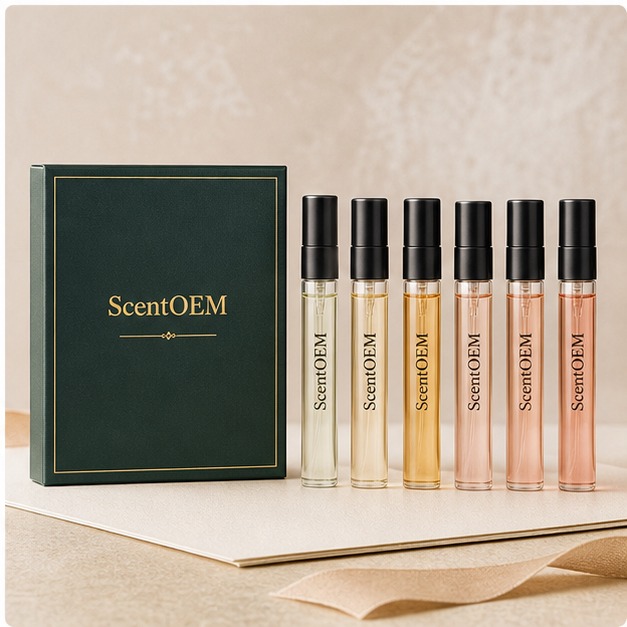
Distinguish between fragrance strips, liquid evaluation samples, packaging samples, decorated samples and a finished pre-production unit. Ask which sample types, quantities and courier costs are included.
Why it matters: a liquid vial can approve scent direction but cannot approve pump performance, decoration or carton fit.
8. How many sample directions and revision rounds are included?
Request the number of initial directions, feedback rounds, included modifications and cost of additional work. Define what counts as a revision versus a new brief.
Why it matters: open-ended sampling creates schedule and fee disputes. A structured feedback process protects both parties.
9. How will bottle, pump and formula compatibility be checked?
Ask what tests or practical evaluations are planned for leakage, spray, crimp, seals, formula interaction, appearance and decoration durability. Request the method, sample configuration and acceptance criteria.
Why it matters: components that look compatible in a catalog may fail as a finished package.
10. Which specification will control mass production?
Ask whether the supplier will issue a product specification identifying formula code, concentration, component codes, decoration, artwork version, fill, coding and quality limits. Confirm that approved samples will be retained.
Why it matters: mass production cannot be measured against a verbal brief or mood board.
11. What quality checks occur before shipment?
Ask for the relevant incoming, in-process and finished-product checkpoints. Discuss sampling plan, defect categories, inspection records, retained samples and release authority.
Why it matters: “QC included” does not explain what is checked or what happens when a result is outside specification.
12. Which documents may be available for this formula and destination?
Ask about SDS, COA, batch information and fragrance-related conformity documents where applicable. Separate manufacturer-supplied information from buyer or responsible-person obligations in the target market.
Why it matters: document names are often used broadly. Availability and suitability depend on the exact formula, intended use and destination.
13. What starts the production lead-time clock?
Ask whether timing begins after deposit, formula approval, artwork approval, component arrival or completion of all pre-production checks. Request stage dates rather than one total number.
Why it matters: a quoted production period may exclude weeks of packaging procurement and approvals.
14. What happens to excess components and failed units?
Define ownership, storage, condition, future use and disposal of unused bottles, pumps, caps, labels and cartons. Also define how nonconforming products are handled and who pays for sorting, rework, replacement or freight.
Why it matters: packaging minimums may exceed the number of finished units, creating hidden inventory and cash exposure.
15. Can the same product be reordered consistently?
Ask how long the fragrance, bottle, pump, cap and packaging route are expected to remain available. Confirm substitution rules, normal reorder minimums, retained samples and change notification.
Why it matters: a successful launch needs a reproducible second order. First-order feasibility without continuity can damage the brand.
A ready-to-send inquiry
We are evaluating private-label perfume production for [destination market]. The project is [number] fragrance(s), [bottle size], approximately [quantity] finished units per scent, using [stock/custom] packaging. Before sampling, please answer the attached 15 questions and identify which values are confirmed, estimated or still subject to component review. Please also separate one-time fees, sample fees, component minimums and finished-product quantity.
Attach a reference sheet showing desired scent direction, bottle style, finish, carton type and target launch window. Label references as inspiration rather than approved specifications.