Best-Fit Project Path
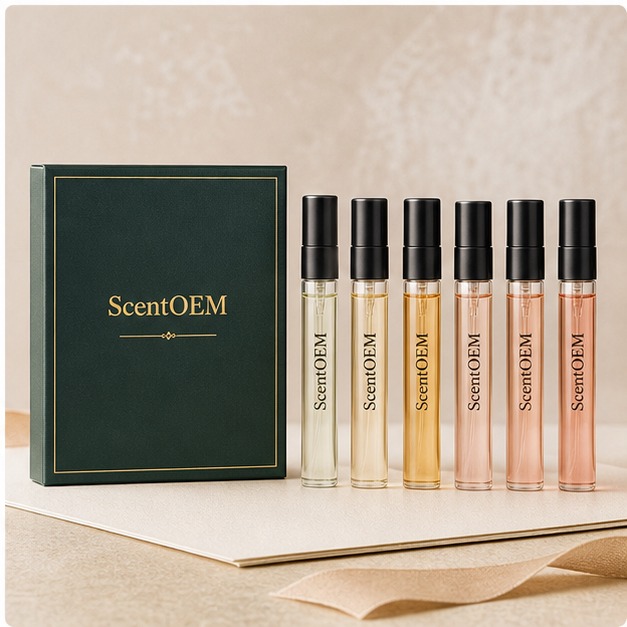
Use a trial-oriented private label path before committing to a large full custom program. Sample kits, multi-SKU testing and packaging feedback can reduce launch risk.
Selling fragrance online carries a structural disadvantage that no other product category faces quite as sharply: the customer cannot experience the product before buying, and knows it. Most of what follows is about reducing the cost of that gap.
The Problem Online Fragrance Has to Solve
A customer browsing an unfamiliar brand is being asked to pay full price for something they cannot assess. The formats that work online are the ones that lower that risk.
| Discovery sets | The most direct answer. Several scents at low commitment, and it returns which direction your buyers prefer before volume is committed. See discovery sets. |
|---|
| Mini and trial formats | A low entry price that converts hesitant buyers, and a natural add-on for existing customers. |
|---|
| Sample-with-purchase | Introduces a second scent to a customer who has already bought once. |
|---|
| Set credit mechanics | Applying a set's price against a later full-size purchase turns trial into a paid step rather than a giveaway. |
|---|
| Descriptive clarity | Scents that can be described in a sentence convert better online, because the description is doing the work smelling would otherwise do. |
|---|
Launching with a discovery set rather than a single full-size product changes what a first run buys. Instead of stock plus a yes-or-no answer, you get stock plus a ranking of which directions your actual customers choose — which is what the second run needs to know.
Packaging for Parcels, Not Shelves
Retail packaging is designed to compete on a shelf and travels protected inside a pallet. Ecommerce packaging travels alone through parcel networks and competes as a thumbnail. The requirements diverge more than most brands expect.
- Transit durability — damage drives returns and reviews, both expensive. The unit must survive handling as a single parcel.
- Dimensional efficiency — parcel pricing responds to package size, so unnecessary bulk is a cost on every order, not once per shipment.
- Thumbnail legibility — the listing image is where the purchase decision happens; a label that reads beautifully in hand may be illegible at listing size.
- Photography behaviour — bottle finish, glass colour and label contrast determine how the product photographs, which is a commercial property, not a cosmetic one.
- Unboxing — the opening moment is content customers photograph and share, making it a marketing asset.
- Barcode and platform files — placement, quiet zone and any channel-required identifiers need planning into the layout.
Unit Economics Online
Selling direct removes distribution margin layers but adds costs that wholesale does not carry. The specification should account for both sides.
| Cost that rises online | Specification implication |
|---|
| Per-parcel shipping | Package dimensions matter on every single order |
| Customer acquisition | Budget must survive inventory, not be consumed by it |
| Returns and damage | Transit protection is cheaper than replacement |
| Payment and platform fees | Factored into the price the product must support |
| Content production | Photography and video are recurring, not one-off |
The practical consequence is that a founder who spends the whole budget on inventory has nothing left to make the product findable — and an unfindable product does not sell however good it is.
Platform and Channel Requirements
Selling platforms set their own rules for fragrance listings, and these sit alongside whatever applies to importing the product.
- Documentation requests may arrive before or after a listing goes live, and requirements differ between platforms.
- Fulfilment restrictions apply to alcohol-based fragrance through some networks and carriers.
- Listing claims are the seller's responsibility, including ingredient, performance and comparison statements.
- Category rules can affect what may be sold, how it is described and which fulfilment options are available.
Confirm platform requirements directly with the platform before building a launch around a channel. They are set by the platform rather than by any supplier, and a listing removed after launch costs far more than the question would have.
What to Prepare
| Sales channel | Marketplace, own store, social commerce, subscription or direct retail — each implies different formats and packaging. |
|---|
| Launch format | Discovery set, mini perfume, full-size product, gift bundle or body mist. |
|---|
| Packaging needs | Mailing durability, product photography, label readability, box size and barcode or platform files. |
|---|
| Price position | Intended retail price, accounting for platform fees, shipping and acquisition cost. |
|---|
| Destination market | Where you are selling and who acts as importer, since this drives label requirements. |
|---|
Ecommerce FAQ
How do you sell fragrance online when customers cannot smell it?
By lowering the cost of trying. Discovery sets, minis and sample-with-purchase all reduce the risk of a first purchase, and set-credit mechanics turn trial into a paid step rather than a giveaway. Scents that can be described clearly also convert better, because the description does the work that smelling would.
Does ecommerce packaging really need to differ from retail?
Substantially. An online unit travels alone through parcel networks rather than protected on a pallet, parcel pricing responds to package dimensions on every order, and the listing image — not the shelf — is where the purchase decision happens. Packaging optimised for a shelf frequently underperforms in fulfilment.
Should a first online launch be a discovery set or a full-size product?
A discovery set is worth serious consideration. It costs more per unit to assemble, but it returns what a first run most needs: a ranking of which fragrance directions your actual customers choose, before volume is committed to one.
What restricts selling perfume on marketplace platforms?
Platforms set their own requirements, including documentation requests and restrictions on shipping alcohol-based products through some fulfilment networks. These differ between platforms and change over time, so confirm directly with the platform before planning a launch around that channel.
How much of the budget should go to inventory?
Less than most founders allocate. Content production, advertising and the working-capital gap between paying for production and being paid all have to come from somewhere. A product nobody can find does not sell regardless of quality, so acquisition budget is not optional.
Continue From Here